Draw Your Own Mandala: Step-by-Step Tutorial
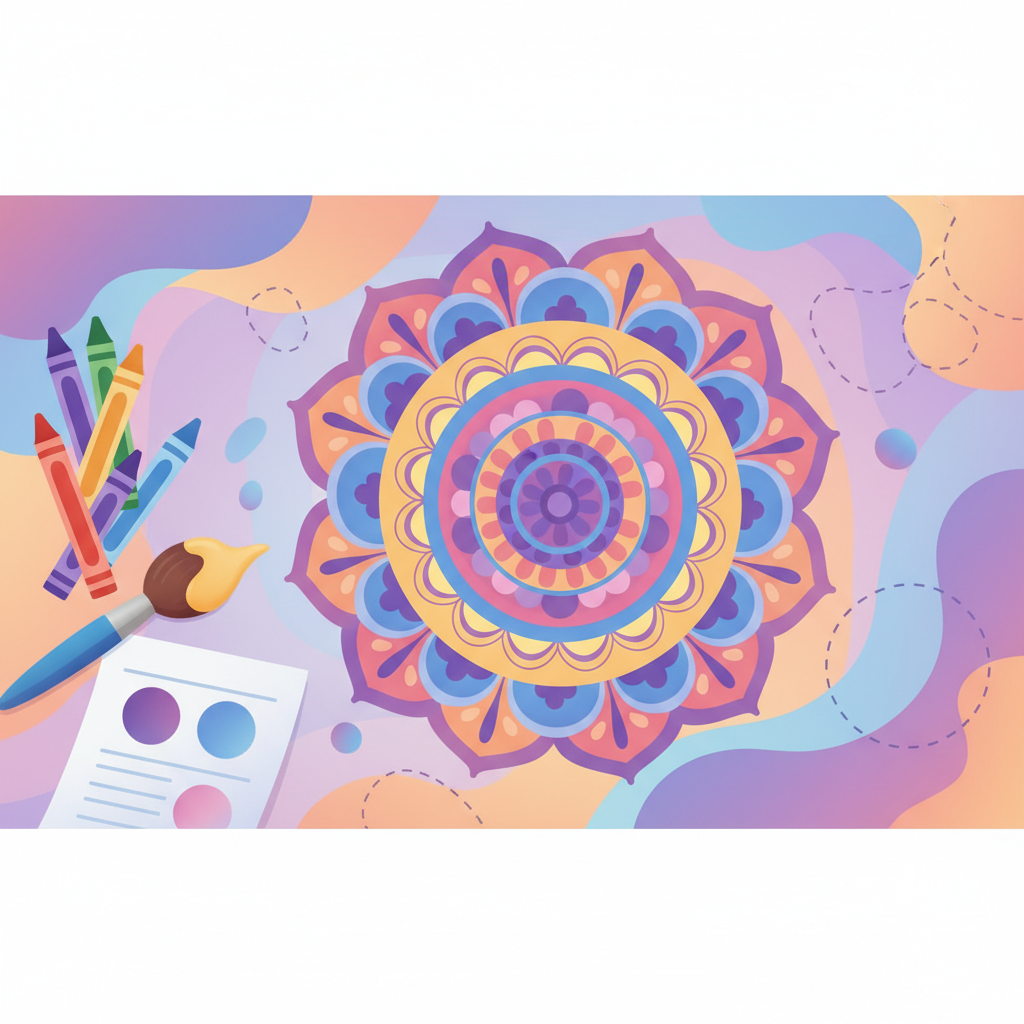
Unveiling the Magic of Mandalas: A Journey of Creativity and Calm
Have you ever found yourself mesmerized by the intricate beauty of a mandala? These captivating circular designs, rich in symbolism and visual harmony, have fascinated cultures for centuries. The word "mandala" comes from Sanskrit, meaning "circle," and represents wholeness, unity, and balance. More than just a pretty pattern, mandalas are often used as tools for meditation, mindfulness, and personal expression.
For families, drawing mandalas offers a wonderful opportunity to engage in a creative activity that is both relaxing and rewarding. It's a fantastic way to develop fine motor skills, concentration, and artistic confidence in children, while adults can find a peaceful escape from daily stresses. Creating your own mandala allows you to infuse it with your unique personality, emotions, and intentions, making it a truly personal work of art. In this step-by-step tutorial, we'll guide you through the process of drawing your very own mandala, transforming a blank page into a vibrant expression of your inner world.
Your Essential Mandala Drawing Toolkit
One of the best things about drawing mandalas is that you don't need a lot of fancy equipment to get started. Most of what you need can probably be found around your home or picked up at a local stationery store. Here’s a simple list to gather before you begin your creative journey:
- Paper: Any paper will do for practice, but a slightly thicker drawing paper or cardstock will hold up better to erasing and coloring.
- Pencil: An HB pencil is perfect for initial sketching, as it's easy to erase. A softer pencil (like 2B or 4B) can be used later for darker lines if desired.
- Eraser: A good quality eraser is essential for correcting mistakes and cleaning up your grid lines.
- Ruler: A straight edge is crucial for drawing precise lines and dividing your circle evenly.
- Compass: This tool is indispensable for drawing perfect concentric circles, which form the backbone of any mandala.
- Protractor (Optional but Recommended): While not strictly necessary, a protractor makes dividing your circles into equal segments much easier and more accurate.
- Coloring Tools: Once your design is complete, you'll want to add color! Colored pencils, markers, gel pens, or even watercolors can bring your mandala to life.
Remember, the goal is to enjoy the process, so don't feel pressured to have the most expensive tools. Simple supplies are often all you need to create something beautiful.
Laying the Foundation: Creating Your Mandala Grid
The secret to a beautifully symmetrical mandala lies in its underlying grid. This framework ensures that your patterns repeat evenly and your design maintains balance. Don't worry, it's simpler than it sounds!
Step 1: Find the Center
Begin by placing your paper on a flat surface. Using your ruler, gently draw two diagonal lines from opposite corners of your paper. Where these two lines intersect is the exact center of your page. Mark this point clearly, but lightly, with your pencil. This will be the anchor for your compass.
Step 2: Draw Your Concentric Circles
Now, take your compass and place its needle point on the center mark you just made. Draw a series of concentric circles, starting with a small one in the middle and gradually increasing the radius for each subsequent circle. Aim for at least 4-6 circles, but you can draw more if you plan for a very intricate design. The key is to keep these lines light, as they are just guides and will be erased later. These circles will define the "layers" or "rings" of your mandala.
Step 3: Divide Your Circles into Sections
This is where you establish the radial symmetry. Place your ruler so it passes through the center point, and draw a straight line from one edge of your largest circle to the opposite edge. This is your first diameter. Now, you need to add more lines to divide your circle into equal segments.
- Using a Ruler Only: You can create 4 sections by drawing another line perpendicular to the first, passing through the center. For 8 sections, you can then draw lines bisecting each of those quadrants.
- Using a Protractor: For more precise divisions, place the center of your protractor on the center point of your circles. Mark angles for your desired number of sections (e.g., for 12 sections, mark every 30 degrees; for 16 sections, mark every 22.5 degrees). Then, use your ruler to draw lines from the center through these marks to the edge of your largest circle. Common divisions are 4, 6, 8, 12, or 16 segments.
You now have a beautiful, symmetrical grid. This is your canvas, ready for your creative patterns!
Building Your Masterpiece: Layers of Design
With your grid in place, it's time for the exciting part: filling your mandala with patterns! The beauty of mandalas comes from their repetitive nature, building outward from the center.
Start from the Center
Begin your design in the very middle, within the smallest circle. You might draw a simple dot, a tiny flower, a star, or a unique geometric shape. This central motif sets the tone for your entire mandala.
Work Outward, Ring by Ring
Move to the next concentric circle. In this ring, you'll draw a pattern that repeats in each of the segments you created with your radial lines. For example, if you have 8 segments, you'll draw the same small petal, arc, or triangle 8 times, once in each segment. Use your grid lines to ensure your shapes are symmetrical and evenly spaced. Think of each segment as a slice of pie – whatever you draw in one slice, you repeat in all the others within that ring.
Vary Your Shapes and Patterns
As you move to larger circles, introduce new shapes and patterns. You can use:
- Curved Lines: Arcs, swirls, teardrops, petals.
- Straight Lines: Triangles, squares, diamonds, zigzags.
- Dots and Dashes: Simple yet effective for adding texture and detail.
- Organic Shapes: Leaves, waves, abstract forms.
Each ring can have a completely different pattern, or you can build upon a previous pattern, making it more elaborate. The key is to maintain symmetry within each ring. Don't be afraid to experiment! If a pattern doesn't look right, simply erase it and try something new.
Embrace Repetition and Flow
The magic of a mandala comes from the repetition. As you draw, you'll notice a natural rhythm emerging. Let your hand flow, allowing the patterns to build upon each other. Continue adding layers of designs until you reach the outermost circle, or until you feel your mandala is complete. Once you are happy with your pencil design, you can go over your final lines with a darker pencil or a fine-tip marker, then carefully erase all the underlying grid lines.
Bringing Your Mandala to Life with Color and Personality
Once your intricate design is complete, coloring is where the true magic happens! This is where your mandala truly comes to life and where you can infuse it with even more personal meaning and energy. There are no strict rules for coloring a mandala, but here are some tips to guide you:
Consider Your Color Palette
Think about the mood you want to evoke. Warm colors (reds, oranges, yellows) can bring energy and passion, while cool colors (blues, greens, purples) often create a sense of calm and tranquility. You might choose a monochromatic palette for a sophisticated look, or a vibrant rainbow for joy. Consider using complementary colors (colors opposite each other on the color wheel) to make certain elements pop.
Symmetry in Color
Just as you used symmetry in your design, you can apply it to your coloring. Repeating color patterns in corresponding segments or rings can enhance the overall harmony of your mandala. For example, if you colored a petal blue in one segment, color the same petal blue in all other segments of that ring.
Shading and Blending
Don't be afraid to experiment with shading to add depth and dimension to your mandala. Using different pressures with colored pencils, or blending colors, can create beautiful gradients and make your shapes appear more three-dimensional. You can make the center of a petal darker and fade to lighter at the edges, for instance.
Personalize Your Creation
Ultimately, your mandala is an extension of you. Let your intuition guide your color choices. There's no right or wrong way to color it. The act of choosing and applying colors can be incredibly meditative and satisfying. If you love exploring different color palettes and want more practice, remember that platforms like Wimolino.com offer a vast collection of free coloring pages, including many intricate mandalas, perfect for honing your coloring skills or finding inspiration for your own designs.
Expanding Your Mandala Horizons
Once you've drawn a few basic mandalas, you might find yourself eager to explore more complex designs and techniques. The world of mandalas is vast and offers endless possibilities for creative expression.
- Experiment with Different Grids: Try dividing your circles into a higher number of segments (e.g., 24 or 32) for incredibly detailed designs. You can also experiment with non-linear grids, like spirals, or use overlapping circles to create unique foundational patterns.
- Vary Your Tools: While pencil and paper are a great starting point, don't hesitate to try different mediums. Fine-tip markers for crisp lines, gel pens for shimmering accents, or even watercolors for soft, flowing effects can transform the look and feel of your mandala.
- Incorporate Themes: Let your interests inspire your mandalas. Create a nature-themed mandala with leaves and flowers, a cosmic mandala with stars and planets, or a mandala inspired by a particular emotion or season.
- Practice Freehand: Once you're comfortable with grids, challenge yourself to draw a mandala without a compass or ruler. This allows for a more organic, fluid design, focusing on intuition and flow rather than strict symmetry.
- Digital Mandalas: If you enjoy digital art, explore apps and software that allow you to create mandalas. Many programs have symmetry tools that make it easy to design complex patterns quickly.
The more you draw, the more your unique style will emerge. Don't be afraid to make mistakes; each one is a learning opportunity. The journey of creating is just as important, if not more so, than the final product.
Embrace Your Inner Mandala Artist
Drawing your own mandala is a deeply personal and enriching experience. It's a journey that combines artistic expression with mindfulness, offering a pathway to relaxation, focus, and self-discovery. From the initial geometric grid to the final burst of color, each step is an opportunity to connect with your inner creativity and find a sense of calm.
Whether you're drawing your own unique mandala, exploring the diverse collection of printable and online coloring pages at Wimolino.com, or simply appreciating the beauty of these intricate designs, remember that the process of creative expression is its own reward
More Articles
Animal Mandalas: The Most Beautiful Templates to Color
Mandalas with animal motifs are especially popular. Discover the most beautiful animal mandalas to color.
Mandala to Print: Free Templates for Kids & Adults
Beautiful mandalas to print for free: from simple to complex, for kids and adults.
Mandalas for Kids: Simple Templates for Beginners
Simple mandalas designed specifically for children: large areas, clear patterns and kid-friendly motifs.